
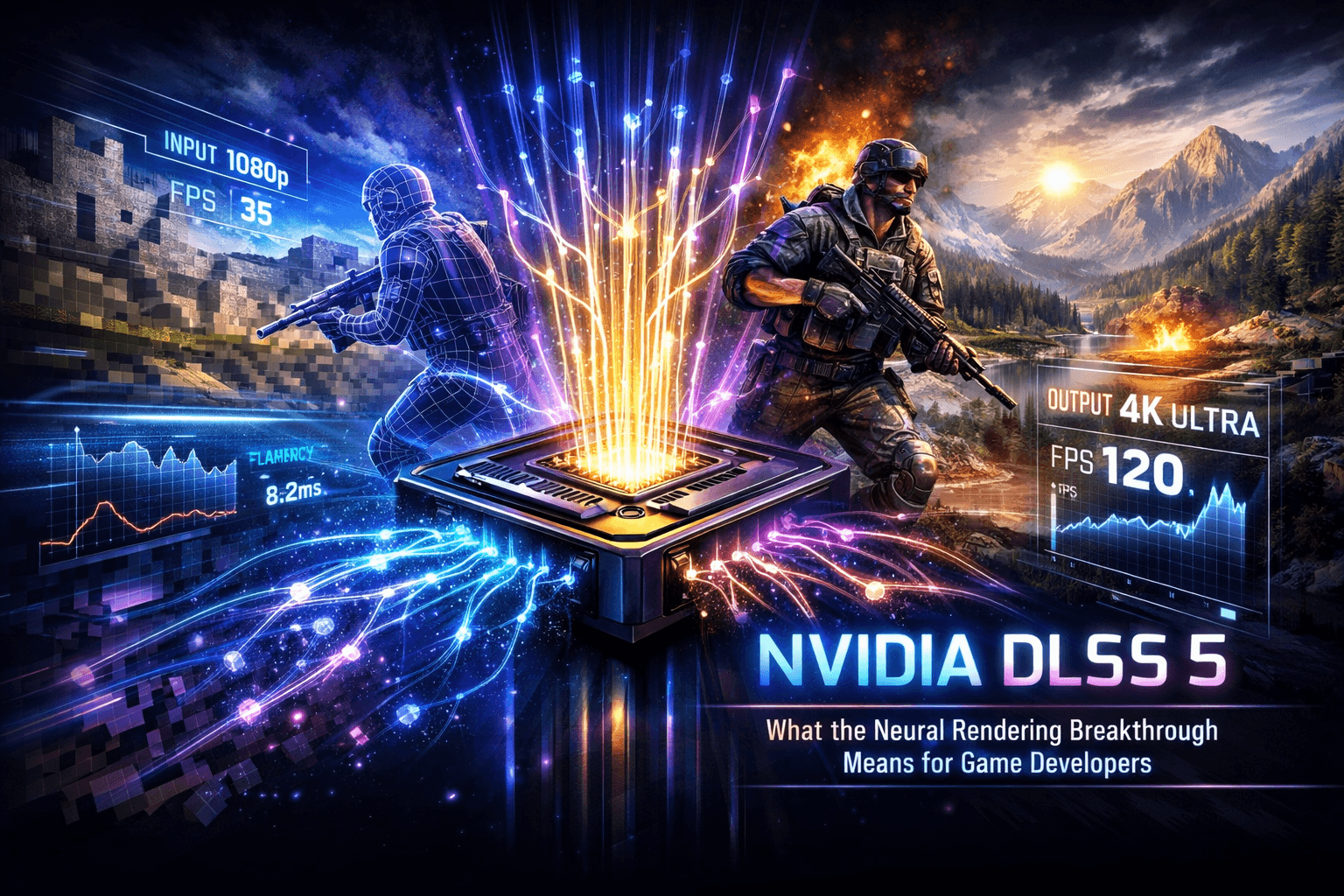
In March 2026, NVIDIA announced DLSS 5, which it describes as its most significant advance in computer graphics since the introduction of real-time ray tracing in 2018. Unlike earlier DLSS versions that focused mainly on upscaling and frame generation, DLSS 5 adds a real-time neural rendering model that enhances visual fidelity: it takes a game's color and motion vectors per frame and uses an AI model to infuse the scene with photoreal lighting and materials while staying anchored to the original 3D content. For game developers, engine programmers, and graphics engineers, the announcement has direct implications for how rendering pipelines are built, how art direction is preserved, and how AI is integrated into production workflows.
From Performance to Fidelity: How DLSS Evolved
DLSS (Deep Learning Super Sampling) launched in 2018 as an AI-based performance technology: upscaling lower-resolution frames to higher resolution to boost frame rates. Later versions added frame generation, so the AI could synthesize entire frames. At CES 2026, NVIDIA announced DLSS 4.5, which uses AI to draw 23 out of every 24 pixels on screen. With DLSS 5, the focus shifts from performance alone to visual quality. The system still runs in real time at up to 4K, but the model is trained to understand scene semantics—characters, hair, fabric, translucent skin—and environmental lighting (front-lit, back-lit, overcast). It then generates lighting and material responses that would be expensive or impractical to compute with traditional real-time methods, while remaining deterministic and temporally stable so that frames are consistent and predictable.
For developers, the important distinction is that DLSS 5 is not a generative video model running offline. Game pixels must be deterministic, delivered in real time, and tightly grounded in the game's 3D world and artistic intent. NVIDIA addresses this by taking the game's own color and motion vectors as input and training the model end-to-end so that its output is anchored to that content. That makes it suitable for integration into existing engines and pipelines without the unpredictability of prompt-based or offline generative tools.
The Technical Pipeline: Inputs, Model, and Output
From an engineering perspective, the DLSS 5 pipeline is straightforward to reason about. For each frame, the game (or engine) provides two main inputs: the current frame's color buffer and motion vectors. The AI model consumes these and produces an enhanced image that adds or refines photoreal lighting and materials. The model is designed to understand complex scene semantics from a single frame—so it can handle subsurface scattering on skin, the sheen of fabric, and light interactions on hair—while preserving the structure and semantics of the original scene. That means developers do not have to hand-author every lighting and material detail; the neural pass can fill in or enhance them in a way that stays consistent with the 3D scene and the artist's intent.
Real-time constraints are strict: a typical game frame has on the order of 16 milliseconds for the entire pipeline. Hollywood VFX frames can take minutes or hours to render with path tracing and global illumination. DLSS 5 does not replace the game's renderer; it runs as a post-process or integrated pass that operates within the frame budget. Running at up to 4K in real time implies that the model and its execution are heavily optimized for NVIDIA GPUs, likely leveraging tensor cores and dedicated AI inference paths that are already used for earlier DLSS versions.
Determinism and Temporal Stability: Why They Matter for Games
Generative AI models used for images or video often produce different results for the same or similar inputs, and they can introduce temporal flicker or inconsistency when applied frame by frame. Games cannot tolerate that: gameplay, replay systems, and streaming depend on deterministic or at least stable rendering. DLSS 5 is explicitly designed to be deterministic and temporally stable, so that the same scene and camera motion produce the same (or very similar) enhanced output across frames. For developers integrating the technology, that means fewer surprises in QA and in production, and no need to treat the AI as a black box that might change the look of a level or character from run to run.
Anchoring to the game's content also matters for correctness. The model is not free to hallucinate new objects or change the layout of the scene; it is conditioned on the game's color and motion, so the output should preserve the structure of the original render. That makes it easier for artists and designers to trust the result and to iterate on the base scene knowing that the neural pass will enhance rather than alter it.
Artist and Developer Controls
NVIDIA states that DLSS 5 provides game developers with detailed controls for intensity, color grading, and masking. That allows artists to decide where and how much the AI enhancement is applied, so that each game can retain its unique aesthetic—stylized, realistic, or somewhere in between. From an integration standpoint, that suggests the SDK or Streamline plugin exposes parameters that can be driven per scene, per material, or per region. Engineers and technical artists will need to wire these controls into their engine or editor so that levels and characters can be tuned without code changes. The fact that integration uses the same NVIDIA Streamline framework as existing DLSS and NVIDIA Reflex technologies should reduce the cost of adoption for teams already using those features.
Streamline and Integration for Engineers
DLSS 5 integrates via the NVIDIA Streamline framework, which is already used for DLSS upscaling, frame generation, and Reflex. That is good news for engine and graphics programmers: the same plugin and hook points can be extended to support DLSS 5, and the pipeline (color + motion vectors in, enhanced image out) fits into the existing post-processing or compositing stage. Teams that have already integrated DLSS 3 or 4 will have a familiar path to evaluate and ship DLSS 5. New integrations will still require supplying the required buffers and configuring the new quality and control options, but the architecture is consistent with what developers already know.
For engine maintainers and middleware providers, the usual considerations apply: support for the correct render targets, motion vector accuracy, and correct handling of HDR and color space. Any neural pass that runs late in the frame can also interact with other post effects (bloom, tone mapping, etc.), so ordering and compatibility will need to be validated per project.
Supported Platforms and Hardware
NVIDIA has not announced minimum GPU requirements for DLSS 5 in the press material, but given the evolution from DLSS 3 and 4, it is reasonable to expect that DLSS 5 will target recent GeForce RTX hardware (e.g., RTX 40 series and newer, and likely RTX 50 series) where tensor cores and AI inference are most capable. Developers targeting a wide range of hardware will need to keep fallback paths: traditional rendering or older DLSS versions when DLSS 5 is not available. As with previous DLSS releases, supporting multiple quality levels and optional toggles will let players and developers balance fidelity and performance.
Publishers and Titles: Who Is Adopting DLSS 5
NVIDIA has announced support from major publishers and studios, including Bethesda, CAPCOM, Hotta Studio, NetEase, NCSOFT, S-GAME, Tencent, Ubisoft, and Warner Bros. Games. Todd Howard (Bethesda) stated that the studio looks to bring DLSS 5 to Starfield and future titles; CAPCOM's Jun Takeuchi highlighted the push for visual fidelity in Resident Evil; and Ubisoft's Charlie Guillemot pointed to Assassin's Creed Shadows as a title where DLSS 5 is enabling the kind of worlds the team has wanted to build. Confirmed or planned games include AION 2, Assassin's Creed Shadows, Black State, CINDER CITY, Delta Force, Hogwarts Legacy, Justice, NARAKA: BLADEPOINT, Phantom Blade Zero, Resident Evil Requiem, Sea of Remnants, Starfield, The Elder Scrolls IV: Oblivion Remastered, Where Winds Meet, and others. For developers at or near these studios, DLSS 5 is likely to become part of the standard toolchain for upcoming projects.
The Broader Context: AI in the Graphics Stack
Jensen Huang has called DLSS 5 "the GPT moment for graphics"—suggesting that the combination of hand-crafted rendering and generative AI is opening a new phase in real-time graphics. NVIDIA's own history illustrates the trend: from programmable shaders (GeForce 3, 2001) and CUDA (GeForce 8800 GTX, 2006) to real-time ray tracing (GeForce RTX 2080 Ti, 2018) and path tracing with neural shaders (GeForce RTX 5090, 2025), the company has pursued both architectural innovation and a massive increase in compute (citing a 375,000x increase since the early 2000s). Even so, the 16-millisecond game frame cannot match the compute budget of a Hollywood VFX frame. DLSS 5 is one answer: use AI to close part of the gap by enhancing the image rather than brute-forcing more rays or samples. For developers, the takeaway is that the rendering pipeline is increasingly hybrid—traditional raster and ray tracing plus neural stages—and that understanding and integrating these stages will be part of the job for graphics and engine programmers.
What Developers Should Do Next
If you are working on a game or engine that already uses Streamline and DLSS, keep an eye on NVIDIA's developer channels and SDK updates for DLSS 5. Plan for the same inputs you already provide (color, motion vectors) and for new parameters (intensity, masking, color grading). If you are evaluating real-time rendering techniques for a new project, DLSS 5 is a candidate for the post-process or compositing stage where you want higher visual fidelity without redesigning the entire renderer. Test on the target RTX hardware and ensure fallbacks and quality tiers are in place for older or non-NVIDIA GPUs. Finally, involve technical artists early so that the new controls are exposed in your editor and pipelines, and so that the look of the game remains under artistic control.
Conclusion
NVIDIA DLSS 5 represents a shift from using AI in games primarily for performance (upscaling, frame generation) to using it for visual fidelity: a real-time neural rendering model that takes color and motion vectors and produces photoreal lighting and materials while staying deterministic and temporally stable. Integration via Streamline, artist controls for intensity and masking, and support from major publishers and titles make it relevant for game developers and graphics engineers. As AI becomes a standard part of the real-time graphics stack, understanding how models like DLSS 5 fit into the pipeline—and how to expose and tune their behavior—will be essential for anyone building or shipping modern games.
For the full announcement, technical details, and previews in Resident Evil Requiem, Starfield, Hogwarts Legacy, and other titles, see NVIDIA's DLSS 5 announcement (March 2026).